
Torque converter stall speed affects towing efficiency because a mismatch between stall speed and engine torque wastes power and builds excess heat in a Duramax Allison transmission. Weavertown Diesel matches stall speed to towing needs so a truck pulls heavy loads without unnecessary slippage or strain.
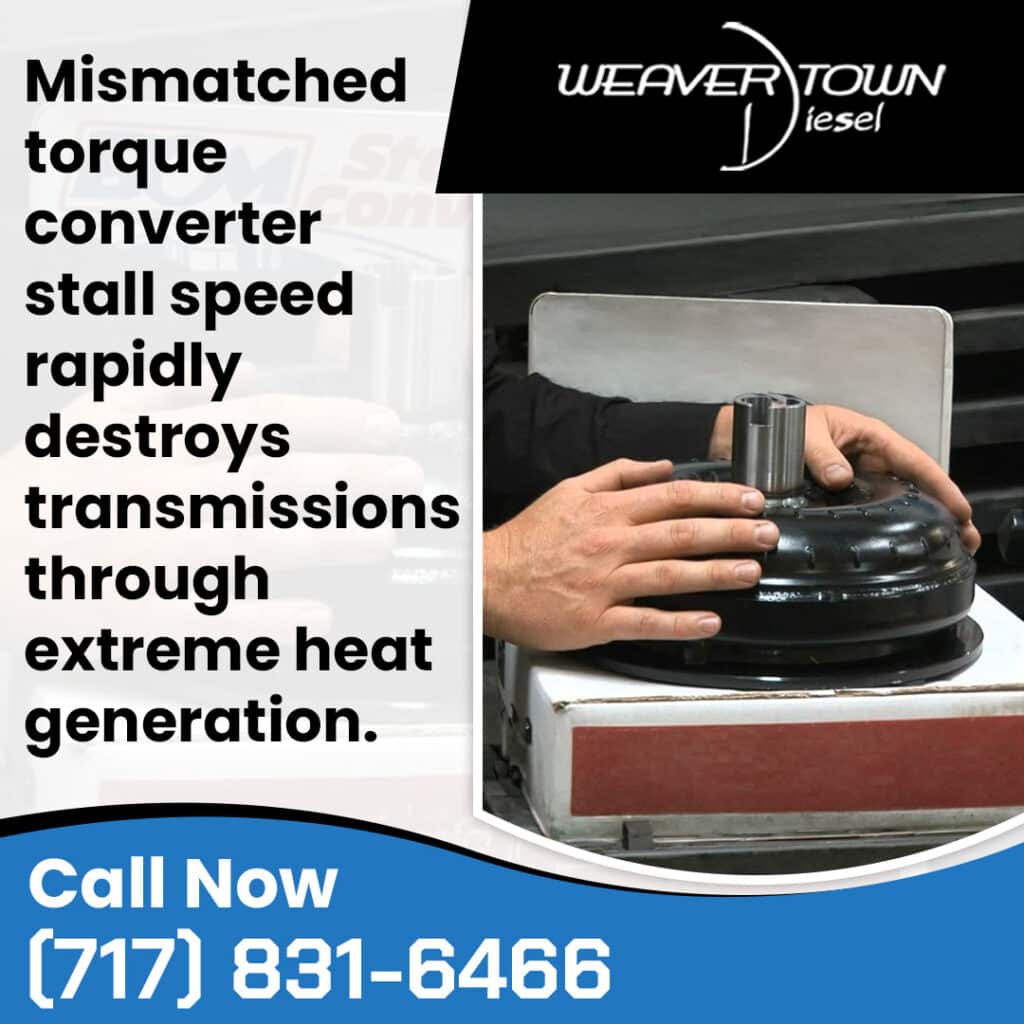
What Is Torque Converter Stall Speed?
Stall speed is the maximum engine RPM reached when the transmission is in gear, the output shaft is held stationary, and full engine torque is applied. It reflects how the torque converter matches engine torque to the drivetrain under maximum load. A lower stall speed sends power to the wheels sooner, while a higher stall speed lets the engine build more RPM first, changing how a truck responds when pulling away from a stop.
How Stall Speed Is Measured
Stall speed is measured during a controlled stall test performed according to the vehicle manufacturer’s procedures. The transmission is placed in gear while the vehicle is securely restrained, engine speed is briefly increased to full throttle, and the highest stabilized RPM is recorded. Extended stall testing should be avoided because transmission temperatures rise rapidly.
Why Does Stall Speed Matter for Towing Efficiency?
Stall speed matters for towing because the converter is least efficient at the stall point, where the turbine is not yet turning, and most of the engine’s effort is converted into heat rather than motion. This is also where torque multiplication is highest, which is useful for getting a loaded truck moving, even though it comes at the expense of efficiency.
According to ScienceDirect’s engineering reference on torque converters, finding the right balance between a suitably high stall torque ratio and strong overall efficiency is a core design goal, since pushing one too far comes at the expense of the other.
How Does a Low Stall Speed Compare to a High Stall Speed for Towing?
| Factor | Low Stall Speed | High Stall Speed |
| Power Delivery | Engages sooner, closer to peak torque | Requires more RPM before engaging |
| Towing Response | Smoother pull-off with a loaded trailer | Can feel like the engine is revving without power |
| Heat Generation | Less time spent at low efficiency | More time spent at low efficiency under load |
| Best Suited For | Heavy, consistent towing | Higher RPM performance or racing use |
For many diesel towing applications, a converter with an appropriately matched lower stall speed allows the engine to reach its usable torque band while reducing unnecessary converter slip.
What Happens When Stall Speed Is Mismatched to a Truck’s Use?
A mismatched stall speed does not just feel inefficient; it shortens the life of a Duramax transmission by keeping it in a low-efficiency state longer than necessary.
Signs Your Stall Speed Doesn’t Match Your Towing Setup
- Engine RPM climbs noticeably before the truck starts pulling
- Transmission temperatures rise faster than expected while towing
- The truck feels like it is working harder than the load should require
- Fuel economy drops more than usual under similar towing conditions
How Do Allison Transmission Upgrades Help Match Stall Speed to Towing Needs?
Allison transmission upgrades that address stall speed are built around how a specific truck is actually used, rather than a factory setting meant to cover average conditions. At Weavertown Diesel, we match converter stall speed to towing weight and driving habits, which keeps the drivetrain operating closer to its most efficient range.
Allison transmissions with a properly matched stall speed give truck owners a more direct path to towing capability than a generic replacement part.
Frequently Asked Questions
Does stall speed affect fuel economy while towing?
Yes. A stall speed that keeps the engine revving without matching wheel speed wastes fuel, especially under sustained towing loads.
Can stall speed be changed without replacing the entire torque converter?
Usually not. Stall speed is built into the converter’s internal design, so changing it typically means installing a converter built for a different range.
Does a higher stall speed always mean more power?
Not necessarily. It can improve high-RPM performance but often works against towing efficiency at lower speeds.
Is stall speed the same as engine redline?
No. Stall speed is the RPM at which the converter begins transferring power, while redline is the engine’s maximum safe RPM.

Ready to Match Your Stall Speed to Your Towing Needs?
The right stall speed keeps a transmission working efficiently instead of fighting against a mismatched converter. Contact Weavertown Diesel at (717) 831-6466 or email [email protected], and our team will help you find the right setup for your truck.