Duramax-powered trucks place continuous demand on their transmission systems during towing and hauling. A Duramax transmission must manage torque load, heat buildup, and repeated shifting while maintaining stable performance under pressure. These conditions become more pronounced as towing weight or engine output increases. Weavertown Diesel focuses on transmission builds designed for real-world load conditions, prioritizing durability and controlled performance under stress.
The Duramax Allison transmission is widely used in diesel trucks due to its strength, yet factory limits become noticeable under heavier operation. This article explains how transmission improvements affect load handling, how stock systems differ from upgraded builds, and what factors matter when selecting transmission options for demanding Duramax applications.
How Heavy Loads Affect Transmission Performance
Heavy towing and hauling change how a transmission responds across heat, torque flow, and shifting behavior. Load conditions directly influence internal wear patterns and how consistently the system maintains gear engagement.
Heat under towing load
A Duramax transmission under sustained towing produces higher internal temperatures due to continuous torque transfer. Heat builds as the load remains steady over longer distances or steep grades. Proper transmission maintenance helps manage heat-related wear over time.
As the temperature rises, transmission fluid loses stability under pressure. This affects clutch grip and shift timing. Over time, extended heat exposure during towing can lead to less consistent gear changes and increased internal stress across moving components.
Torque stress changes
Load weight changes how torque moves through the drivetrain. A Duramax Allison transmission handles torque differently under repeated acceleration with heavy load compared to lighter driving conditions.
During loaded operation, the torque remains engaged longer between shifts. These places added stress on clutch packs and supporting components. Repeated cycles of this type gradually increase wear, especially in setups operating near factory torque limits. Diesel owners exploring custom Allison transmission upgrades often do so to address exactly this kind of stress.
Stop-start hauling strain
Frequent stopping and starting create repeated engagement cycles inside the transmission. Each cycle requires controlled clutch application under load, increasing mechanical demand. This pattern is common in delivery routes, job-site movement, and trailer repositioning.
A Duramax transmission operating in these conditions experiences more shift events in a shorter timeframe, which accelerates wear compared to steady highway towing, where the load remains more constant.
Why Stock Allison Transmission Setups Reach Their Limits
Factory-built transmissions in Duramax applications are designed around balanced road use, not continuous heavy towing or increased engine output. Under higher load conditions, limitations begin to show in shift behavior, torque handling, and thermal control.
Factory tuning limits
Stock calibration in a Duramax Allison transmission is set to support smooth operation across everyday driving conditions. Shift timing and line pressure are programmed for comfort and efficiency rather than sustained load control. Under repeated towing or steep-grade driving, this calibration may not maintain consistent shift firmness or timing.
As the load increases, the transmission may take longer to complete gear changes. This behavior change reflects how factory settings manage pressure distribution across internal components rather than adapting to prolonged stress conditions.
Clutch capacity limits
Factory clutch packs in a transmission are designed for general use across a wide range of driving situations. These components handle normal torque levels effectively but operate closer to their capacity under frequent heavy hauling.
Under sustained load, clutch engagement becomes more demanding. This can lead to early signs of slip or delayed response during shifts, especially in applications where towing is frequent or vehicle weight remains high over long periods.
Heat breakdown risk
Heat plays a major role in limiting stock transmission performance. As operating temperatures remain elevated, transmission fluid begins to lose stability and protective qualities.
In an Allison transmission, extended heat exposure affects lubrication and hydraulic pressure consistency. Over time, this condition increases internal wear rates and reduces the system’s ability to maintain stable shifting under repeated load cycles.
Matching Transmission Builds to Real Load Conditions
Different towing and hauling patterns place different demands on a transmission. A Duramax Allison transmission responds based on how often load is applied, how long it is sustained, and how much weight is being moved. Build selection should reflect actual use patterns rather than general assumptions.
Daily towing use
Consistent towing places repeated load cycles on the transmission across regular driving routes. Stability in shift behavior and clutch response becomes important when towing happens several times a week.
In this type of use, many considerations around Allison transmissions for sale focus on how the build handles repeated engagement without variation in performance. Load consistency matters more than peak power capacity, since stress is applied frequently rather than in short bursts.
Highway hauling use
Long-distance hauling introduces extended periods of steady load at cruising speed. Gear ratios and fluid temperature control play a central role in maintaining consistent operation over time.
A transmission in highway towing use experiences less shifting frequency but longer load duration. This places focus on thermal management and steady torque handling rather than rapid engagement cycles.
Heavy-duty work use
Commercial-style hauling combines high-weight loads with frequent starts, stops, and varied driving conditions. This creates continuous stress across multiple transmission functions at once.
In this setting, an Allison transmission requires stronger internal support for torque handling and heat control. Build quality becomes more relevant than factory configuration since operating conditions often exceed standard duty cycles.
Core Areas That Influence Transmission Strength and Control
Transmission performance under load depends on how well key internal systems manage torque, pressure, and heat together. A Duramax transmission does not rely on a single upgrade point; it functions as a coordinated system where each area affects the next.
Torque converter strength
A reinforced torque converter improves how engine power is transferred into the drivetrain under load. It reduces inefficiency during heavy acceleration and supports smoother torque multiplication during towing conditions.
In upgraded setups, this component is commonly paired with Allison transmission upgrades that help the system maintain consistent behavior under higher stress. The converter plays a direct role in how the transmission responds when load demand increases.
Clutch holding power
Clutch capacity determines how well the transmission maintains engagement during gear changes. When holding power is limited, slip can occur under load, which affects shift stability and long-term wear patterns.
In an Allison transmission setup, stronger clutch materials and improved apply characteristics help maintain consistent engagement. This becomes more important as towing weight increases or when power levels exceed factory calibration ranges.
Hydraulic pressure control
Hydraulic pressure regulates how force is applied to internal components during shifts. If pressure varies under load, gear changes may become inconsistent or delayed.
Stable pressure control allows the transmission to maintain predictable shift timing across different driving conditions. In heavy-use applications, pressure consistency supports smoother transitions between gears even when torque demand changes quickly.
Cooling support systems
Heat management directly influences transmission durability under towing conditions. As operating temperatures rise, fluid performance changes and internal wear increase over time.
A Duramax transmission used for towing benefits from improved cooling support through enhanced fluid capacity and heat dissipation. Managing temperature helps maintain stable operation during extended load periods where heat buildup is continuous rather than temporary.
What Defines a Built Allison Transmission Upgrade System
A built transmission system is designed to handle higher load demand by improving internal strength and shift behavior. In a Duramax transmission setup, changes focus on durability, control, and consistent performance under towing and power increases.
Internal component changes
Built systems replace or reinforce key internal parts to handle higher stress levels.
- Upgraded clutch materials for stronger engagement
- Reinforced hard parts for improved load handling
- Improved internal assemblies for durability under repeated strain
These Allison transmission upgrades support more stable operation under load by reducing slippage and improving consistency across gear changes.
Shift control updates
Shift behavior is adjusted to improve how the transmission responds under pressure.
- Valve body modifications for improved pressure flow
- Updated shift timing for smoother engagement
- More consistent gear changes under towing load
- Reduced hesitation during torque changes
These adjustments help the system maintain controlled shifting when load conditions change quickly, especially during towing or grade driving.
Build level selection
Different build levels are designed to match specific horsepower ranges and workload conditions. Each level defines how much internal reinforcement and control modification is included.
Buyers reviewing Allison transmissions for sale often compare build levels to match expected towing weight, engine output, and long-term usage patterns. Selecting the correct level helps align transmission capability with real operating demands rather than general specifications.
How Weavertown Diesel Structures Heavy-Duty Transmission Builds
Heavy-duty transmission builds require consistent assembly standards and carefully selected components that match real towing and hauling conditions. Weavertown Diesel designs each build around how the system responds to torque load, heat, and repeated shifting over time.
In-house assembly process
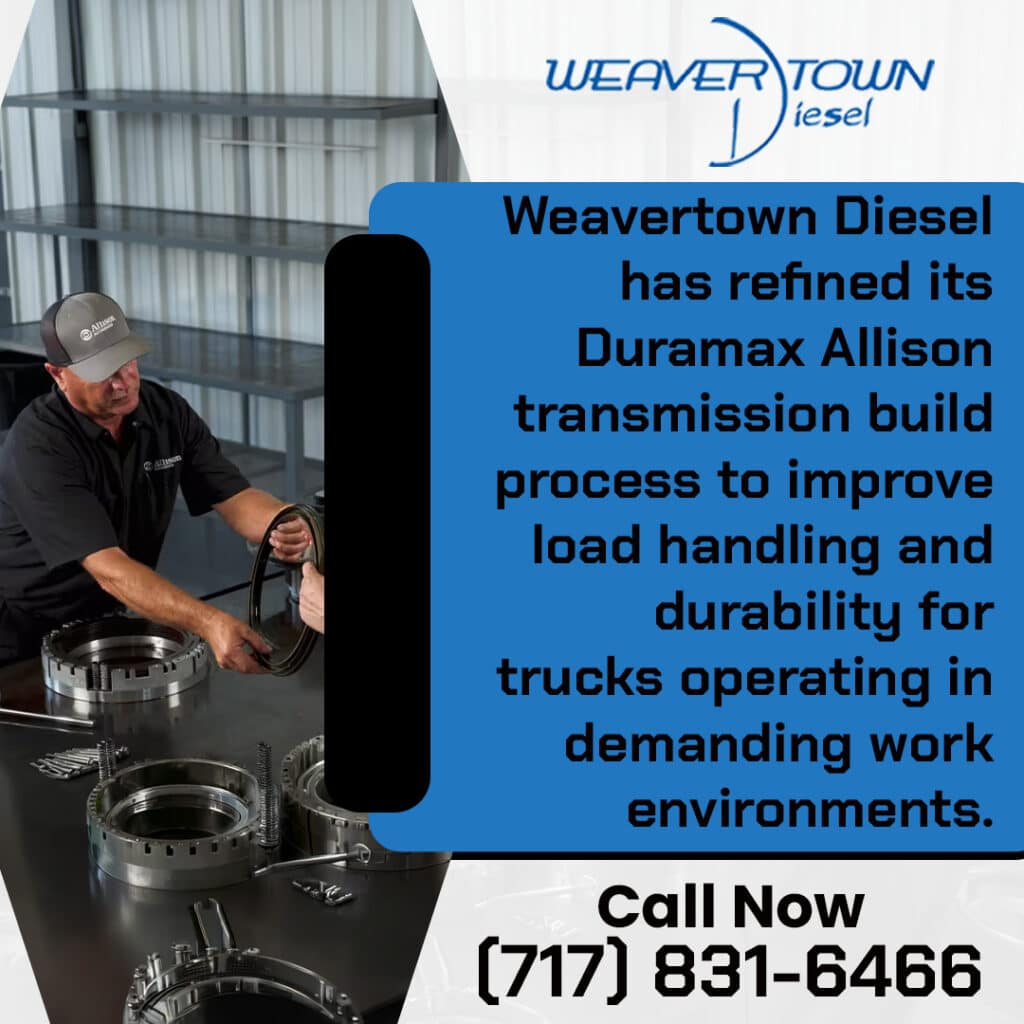
Every unit at Weavertown Diesel goes through a controlled in-house process from start to finish. We fully disassemble each transmission before inspection so we can evaluate every internal component individually. After inspection, we clean all parts thoroughly to remove wear material and buildup before reassembly begins.
During assembly, our team applies torque specifications with precision to maintain consistent build quality across all units. Before any transmission leaves our shop, we complete a final inspection to confirm assembly standards and internal setup. This process supports consistent results in applications where load conditions vary from truck to truck.
Load-focused part selection
Weavertown Diesel selects every component based on real towing and hauling demands rather than general replacement standards. Clutch materials are matched to torque levels commonly seen in heavy-use Duramax transmission setups, while torque converters are chosen based on actual workload conditions.
Internal components are selected with heat resistance and durability in mind since temperature control plays a direct role in transmission stability. We also match electronic components to shift behavior requirements so engagement remains consistent under changing load conditions. This approach helps maintain reliable performance in demanding environments.
750HP build setup
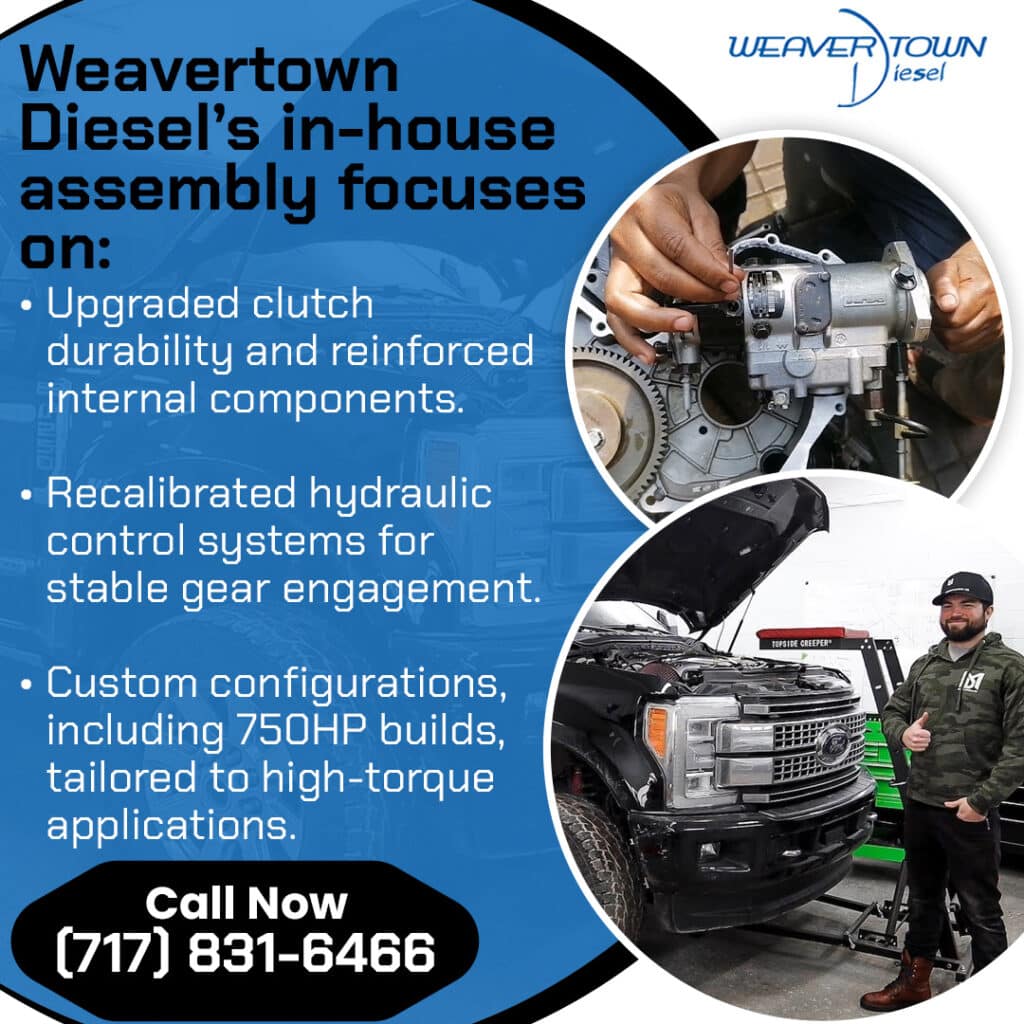
Weavertown Diesel’s 750HP configuration is designed for higher torque output and sustained load handling. Internal components are reinforced to handle increased stress across clutch assemblies and hard parts. The hydraulic system is calibrated to maintain stable pressure under load, while the torque converter is upgraded to support stronger torque transfer.
Our team also integrates electronic components that support controlled shift behavior during high-demand operation. This setup aligns with advanced Allison transmission upgrades and is built for applications where both power and towing load place continuous demand on the system.
Upgrade Your Duramax Transmission with Weavertown Diesel
Heavy towing and demanding workloads require a transmission setup built for real conditions, not assumptions. Weavertown Diesel builds and supports Duramax transmission solutions designed for durability, controlled performance, and long-term use under load.
For questions about builds, availability of Duramax Allison transmission options, or details on Allison transmission upgrades, contact our team at (717) 831-6466 or email [email protected].