Turbo size sets how fast your Duramax builds boost and how much power it makes at higher RPM. At Weavertown Diesel, we match turbo size to how you drive- towing, daily use, or performance- for strong response without losing top-end power.
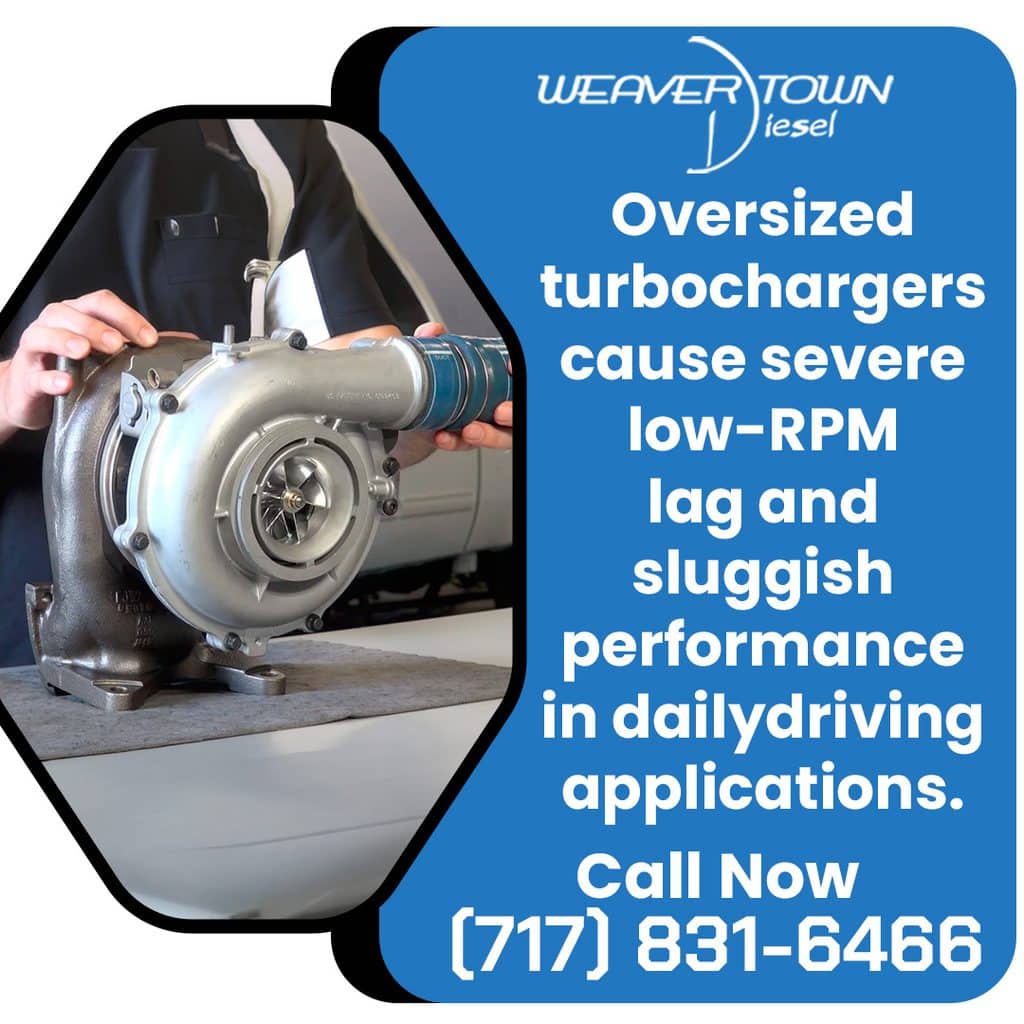
If you’ve shopped for Duramax turbos, you’ve likely seen sizing charts and A/R ratios and wondered what they mean for your truck. Bigger isn’t always better: a turbo too large feels sluggish at low RPM, while one too small runs out of air past 3,500 RPM.
What Determines Turbo Size on a Duramax?
Turbo size comes down to the compressor wheel, the turbine wheel, and the A/R ratio of the housing. The compressor pressurizes intake air, the turbine spins it using exhaust energy, and the A/R ratio controls how fast exhaust reaches the turbine.
A small compressor and turbine spin up fast, so boost arrives early. A larger set takes longer to spin but moves more air once up to speed. This logic applies across most Duramax turbos: size decides where power shows up in the RPM range, not just how much there is.
As FuelEconomy.gov notes, turbochargers compress additional air into the cylinders so a smaller engine can produce more power without sacrificing efficiency.
How Does Turbo Size Affect Boost and Power Delivery?
Turbo size affects spool (how soon boost arrives) and ceiling (how much air it can eventually deliver). A smaller turbo spools sooner and feels responsive around town or under a trailer. A larger turbo spools later but keeps pulling well past where a smaller unit runs out.
| Turbo Size | Spool Speed | Power Ceiling | Best Suited For |
| Small / stock-sized | Fast | Lower | Daily driving, light towing |
| Mid-size | Moderate | Moderate-high | Mixed towing and performance |
| Large | Slower | Highest | Dedicated performance builds |
Why Do LB7 Owners Often Upgrade First?
LB7 trucks are often the starting point for turbo conversations because the factory unit was sized for stock power, not heavy towing or added fueling. A properly matched Duramax LB7 turbo upgrade restores the responsiveness the truck had when new.
What Turbo Upgrades Work Best for LBZ and LML Trucks?
LBZ and LML trucks start from a stronger factory baseline, so the right path depends on the goal. An LML Duramax turbo upgrade often comes up when chasing higher horsepower on top of added fueling, while a turbo for LBZ Duramax is more often about towing heat and response:
- Towing-focused builds benefit most from a turbo sized for quick spool and steady EGT control
- Mixed street and tow setups do well with a moderate step up in compressor size
- Performance builds chasing higher horsepower need a larger compressor and matched turbine housing
Matching size to the use case, not the biggest number on a spec sheet, is what makes any LML Duramax turbo upgrade worth the investment. Our team at Weavertown Diesel builds and tests each unit in-house, so the turbo you install is sized for what you actually plan to do with the truck.
Frequently Asked Questions
Does a bigger turbo always mean more horsepower?
Not on its own. A larger turbo raises the ceiling, but without matching fuel and tuning, it can feel slower at low RPM than a smaller unit.
How long does a properly sized turbo last?
A correctly matched turbo, kept within normal EGT and boost limits, generally lasts as long as the factory unit or longer.
Do I need supporting mods when upgrading turbo size?
Often yes. Fueling and tuning usually need to match the new turbo for the whole system to work together.
Ready to Find the Right Turbo Size for Your Truck?
Not sure which size fits your build or towing needs? Weavertown Diesel can help you land on the right fit before you buy. Call us at (717) 831-6466 or email [email protected] to talk through your setup.