Pushing a Duramax to its limits takes more than a single upgrade. The engine and transmission are two halves of the same system, and when one side gets attention without the other, the results are often disappointing or outright damaging. For Duramax owners looking to build real, lasting power, pairing the right engine mods with a properly built Allison transmission is the approach that actually holds up over time.
At Weavertown Diesel, our focus has always been on building complete powertrain solutions, not just individual components. From performance Allison transmission upgrades to rebuilt Duramax engines, every product is built in-house, tested before it ships, and designed to work as part of a matched system rather than a standalone fix.
Why the Allison Transmission Is the Right Foundation
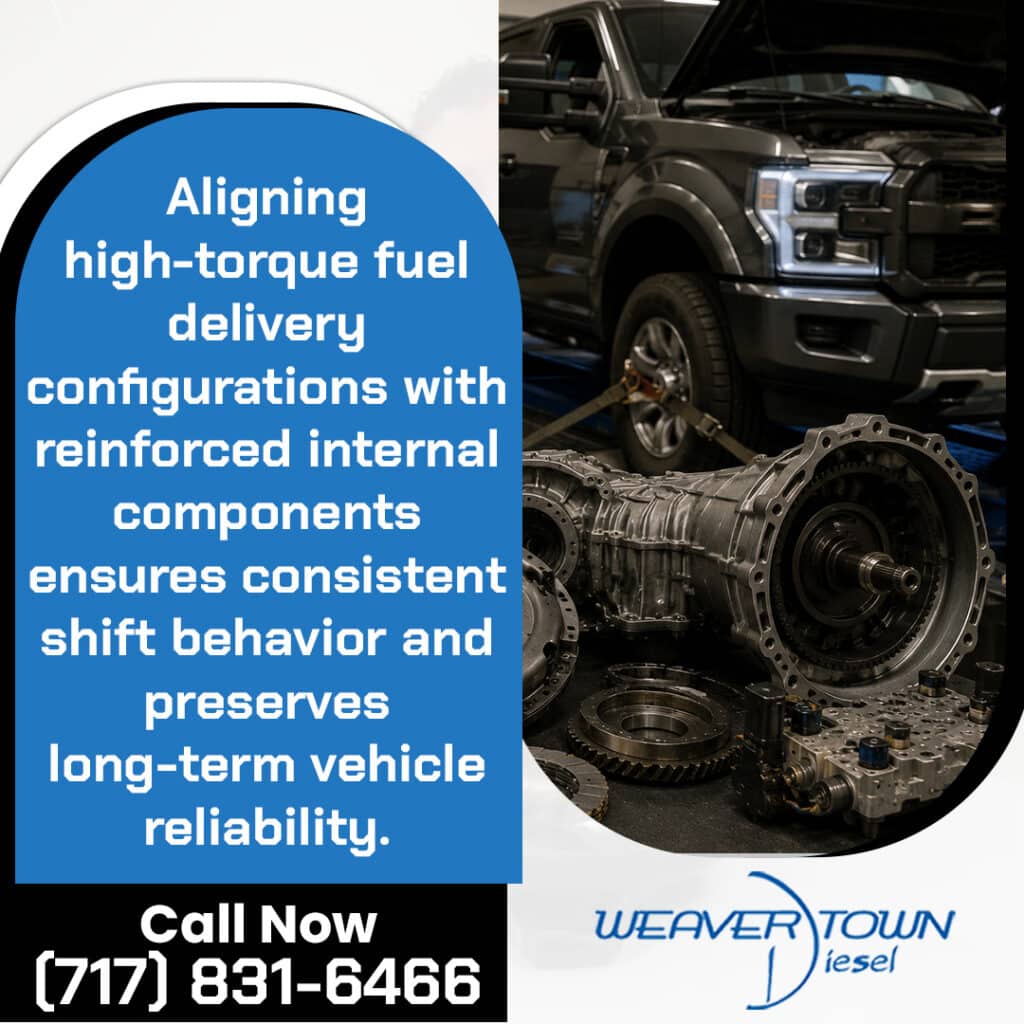
The Allison 1000 series has served as the standard transmission behind heavy-duty diesel trucks since 2001. It’s a six-speed automatic built with durability in mind, and its core design is well-suited to the torque demands of a Duramax engine. The issue isn’t the platform; it’s that factory tolerances and clutch specifications were set for stock power levels, not the output that comes from a modified engine.
Here’s where the factory setup falls short for performance use:
- Stock clutch packs not rated for modified output
- Factory tolerances set for stock power levels
- No heat management for towing or hard use
- Shift programming tuned for economy, not performance
A Duramax Allison transmission that’s been properly rebuilt addresses each of these points from the ground up. Complete disassembly, inspection, and reassembly to tighter specs gives the unit the ability to handle power that the factory version wasn’t calibrated for. That rebuilt foundation is what allows the engine mods below to work as intended, rather than accelerating drivetrain wear. Without it, every modification made to the engine is working against a transmission that isn’t equipped to receive it, and the weak link in the system becomes the most expensive one to fix.
What a Performance Allison Build Includes
Before pairing engine mods with a built transmission, it’s worth understanding what separates a performance Allison build from a stock unit. A quality Allison transmission upgrade typically includes:
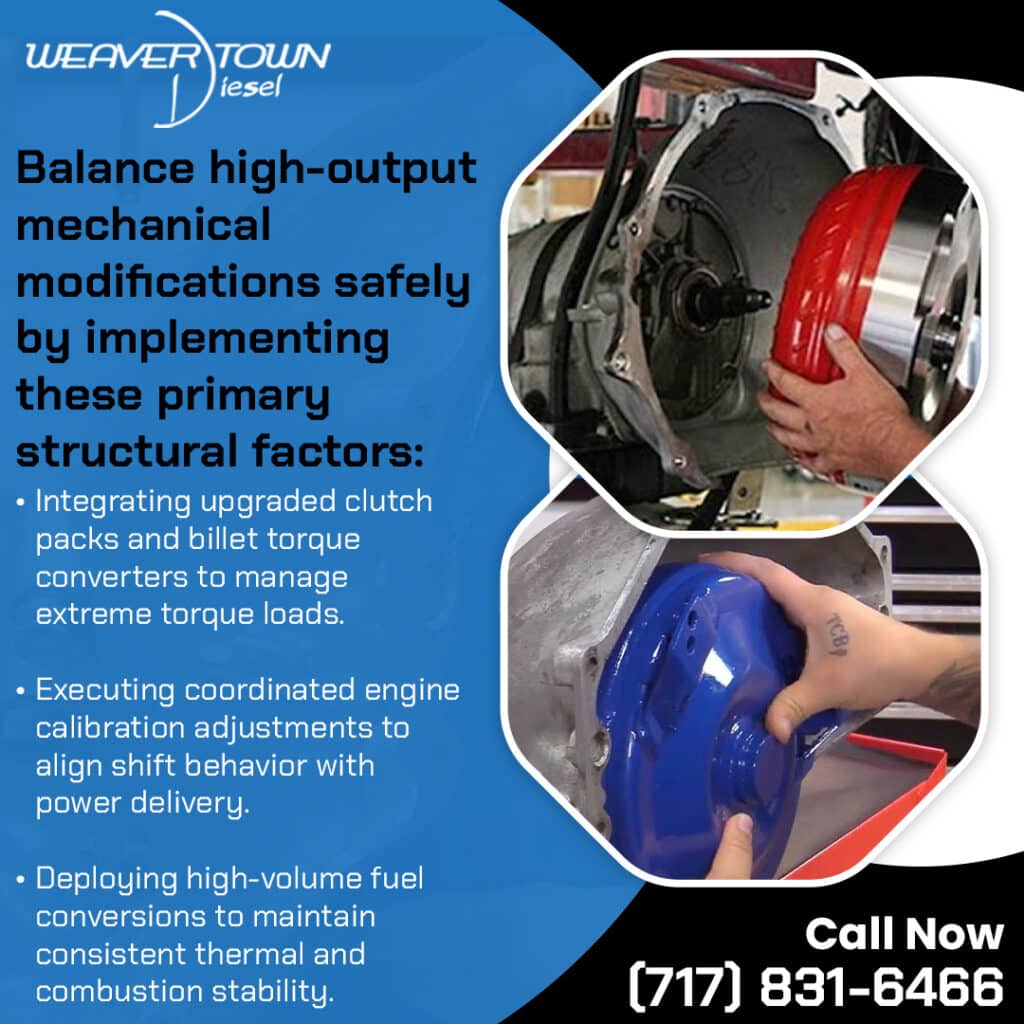
- Full billet triple-disc torque converter
- Upgraded pistons and return springs for quicker shifts
- Performance friction material chosen by application
- Custom pump and stator modifications
- Steel shift valves
- Deep oil pan for increased fluid capacity
- New solenoids, wiring harness, and pressure manifold switch
These components work together to raise the durability ceiling of the Duramax transmission as a whole. It’s not enough to swap in a single upgraded part and expect the rest of the unit to hold up. A proper build addresses the clutch packs, the fluid management system, the electronics, and the torque converter together, because each one affects how the others perform under load.
For example, Weavertown Diesel rates its Allison transmission build at up to 750 horsepower, a range that covers many street-driven and towing-focused Duramax applications. They’re what make the following engine mods a smart investment rather than a liability.
Engine Mods That Work Best With a Built Allison
Each of the following modifications adds power in a way that benefits from the stability and capacity of a performance-built Duramax Allison transmission. They’re listed in order of impact, though most complete builds will include several of them together. The more of these mods that are stacked, the more important it becomes that the transmission underneath them is built to absorb the combined output.
Performance Injectors
Injector upgrades are one of the most direct ways to add power to a Duramax. Higher-flow injectors increase the amount of fuel delivered per cycle, which raises torque output at the crankshaft. Injector upgrades can support higher fuel delivery and increased power output when paired with adequate airflow, tuning, and fuel system capacity.
The challenge is that increased torque places a heavier load on the transmission. A stock unit struggles to manage that added stress, often showing clutch slip or overheating under repeated use. A rebuilt Allison handles those torque increases without issue, making injector upgrades a reliable first step in a staged build.
High-Flow Fuel Injection Pump CP3 Conversion
As fuel demand increases with bigger injectors and higher power targets, the factory injection pump becomes a limiting factor. A CP3 conversion helps maintain commanded fuel rail pressure and provides additional fuel volume capacity under higher-demand operating conditions.
The benefit isn’t just more power, it’s more consistent power. Stable fuel delivery produces even combustion across the RPM range, which smooths out the torque curve. It also reduces the kind of abrupt power spikes that place irregular stress on transmission clutch packs and shift timing.
Upgraded Turbocharger
A performance turbocharger compresses more air into the combustion chamber, allowing the engine to burn more fuel and produce more power across a broader RPM range. According to the U.S. Environmental Protection Agency, turbochargers allow engines to perform like larger displacement units when needed while maintaining efficiency at lower load levels. Selecting the right turbo is less about maximum boost and more about how that boost builds in relation to injector sizing and engine tune.
An oversized or poorly matched turbo creates erratic boost delivery, which translates into torque spikes that are hard on transmission internals. A properly sized turbo produces a progressive, predictable boost curve, one that a performance-built Allison can manage cleanly through each gear shift.
Performance Tune and ECM Calibration
A tune is what ties the hardware together. ECM (Engine Control Module) calibration sets fueling targets, boost curves, and ignition timing so every component works within its intended range. Without a tune, upgraded injectors, a new turbo, and a CP3 conversion are all operating on factory software that wasn’t written to accommodate them.
The transmission side of a tune is equally important. Shift points, torque converter lockup timing, and line pressure are all influenced by how the engine delivers its power. A calibration that matches engine output to the transmission’s shift strategy produces consistent clutch engagement, reduced valve body wear, and more predictable behavior under load.
Cold Air Intake and Exhaust Upgrades
Intake and exhaust upgrades are supporting modifications rather than primary power adders. Their value lies in removing restrictions that limit how well the rest of the build performs. A cold air intake lowers intake temperatures and reduces airflow restriction. A performance exhaust reduces backpressure and helps the turbocharger operate more efficiently.
Together, these upgrades keep the engine running at lower operating temperatures during high-demand situations. Improved engine efficiency can help reduce overall vehicle thermal load, while proper transmission cooling remains critical for maintaining transmission-fluid temperature and clutch longevity. For trucks used in towing applications, this difference in operating temperature can have a meaningful impact on how long the build lasts between services.
A Rebuilt Performance Duramax Engine
For builds targeting the upper end of the power range, starting with a rebuilt engine removes the uncertainty that comes with a stock block running near its limits. A performance Duramax engine build addresses the bottom end, head gaskets, and other components that become failure points at higher output levels.
When the engine and transmission are both built to the same power ceiling, the two units complement each other rather than competing. The engine produces steady, consistent output, and the transmission has the capacity to handle it, which is what a complete, reliable performance build looks like in practice. Skipping the engine rebuild and relying on a stock bottom end under high power levels is one of the more common reasons builds fall short of expectations after everything else has been done right.
Why Power Level Matching Matters
One of the most common and costly mistakes in a Duramax build is mismatching the power capacity of the engine and the Duramax transmission. Adding engine modifications that push output to 700 or 800HP while leaving the transmission stock or with an earlier, lower-rated rebuild results in accelerated wear and eventual failure.
The goal is to bring both components to the same power ceiling. A transmission rated to 750HP should be paired with engine modifications that fall within that range. Going beyond it without a corresponding transmission upgrade shifts the weak point to the transmission, and that becomes an expensive correction.
It’s also worth thinking about the order of the build. Many owners start with engine mods and plan to address the transmission later, but running a built engine against a stock or lightly built Allison puts hours of wear on the transmission before it ever gets the attention it needs. Getting the transmission built first, or at the same time as the major engine work, is a more cost-effective approach in the long run.
Finding Quality Allison Transmissions for Sale
When shopping for Allison transmissions for sale, the build process matters more than the price. A quality rebuild involves complete disassembly, manual tolerance-setting, friction material selected by application, and thorough testing before the unit ships. Those steps can’t be skipped without affecting real-world performance, and units assembled quickly from generic parts tend to fall short once they’re behind a modified engine.
Weavertown Diesel has been building Allison transmissions in-house since 2017. Here’s what goes into every build:
Build Rating and Coverage
Every Weavertown Diesel Allison build is rated to 750HP and covers model years 2001 through 2019. That range spans the full run of Duramax-equipped GM trucks where the Allison 1000 was used, and the 750HP rating covers the output ceiling of most street and towing applications without leaving power on the table.
Disassembly and Inspection
Every unit starts with a complete teardown. Nothing is rebuilt on the bench without being pulled apart first. Each component is inspected before reassembly, and anything that doesn’t meet spec gets replaced. This step is what separates a real rebuild from a parts swap.
Clutch Selection and Tolerances
Clutch material is selected by application using Raybestos, Altos, and Borg Warner friction material, depending on the build. Tolerances are set manually rather than relying on prebuilt kit specifications. This level of hand-fitting is what allows the transmission to hold at higher power levels where generic kits begin to slip.
Put Together a Duramax Powertrain That Lasts
Building a Duramax powertrain that holds up under real performance use starts with getting both the engine and transmission to the same spec. The modifications covered above work best when the transmission has been built to match the power they produce. Call our team at Weavertown Diesel at (717) 831-6466 or email [email protected] to discuss a specific build.